Datadog Costs More Than Your App. Here's What's Going On.

A developer on Hacker News put it perfectly: "Datadog costs more to monitor your AWS t3.medium instance than the actual instance."
That's not an exaggeration. The median Datadog buyer pays $152,340 per year. Coinbase signed a $65 million contract. DHH got quoted $83,000 for a renewal and canceled on the spot.
If you built your app with Cursor or Claude Code and you're looking at Datadog to monitor it, stop. You're about to walk into a pricing model designed for Fortune 500 infrastructure teams, not solo founders.
How the bill gets out of control
Datadog's pricing looks reasonable on the surface. $15/host/month for infrastructure monitoring. $31/host/month for APM. But the way they measure usage creates surprises.
High-water mark billing
Datadog checks your host count every hour, drops the top 1%, and bills for the highest remaining hour across the entire month. So if a traffic spike scales you from 50 to 200 hosts for five days, you pay as if you ran 200 hosts all month. That's a $6,200 APM bill versus the $2,260 you expected.
Custom metrics that multiply
This is where it gets wild. A single metric with 10 endpoints, 3 status codes, 3 customer tiers, and 1,000 customer IDs creates 90,000 custom metrics. At Datadog's rates, that's $4,500 per month from one metric. Teams have gotten six-figure bills from a single misconfiguration.
One engineer put it this way: "I approved a dashboard build, not a 5-figure monthly logging bill."
You pay more when things break
Datadog charges separately for log ingestion ($0.10/GB) and log indexing ($1.70 per million events). A bad deploy that 10x's your log volume? You just added hundreds of dollars to your bill in hours. The monitoring tool charges you more precisely when you need it most.
A Sysdig comparison found Datadog charging $1,030,950 per month versus $100,150 for equivalent workload on their platform. Ten to one.
750 integrations you'll never open
Datadog has 20+ products. For a company with a dedicated SRE team, that's a selling point. For a solo founder who shipped with Cursor last week, it's a wall of dashboards that all say things you don't understand.
User reviews on G2 call it "overwhelming" and "better suited for experienced professionals rather than beginners." Setting up custom metrics is "complex and time-consuming." I keep running into people in the vibe coding community who signed up, saw the dashboard, and closed the tab.
If you're not sure what distributed tracing means, Datadog's UI won't teach you. It'll give you more things to not understand.
Good luck leaving
Once you're instrumented with Datadog agents, leaving is expensive by design. Their agents use a proprietary format, not standard OpenTelemetry. Your dashboards and monitors are trapped in the platform.
Small teams budget 2-4 weeks of engineering time for migration. One company had 400 dashboards and 1,200 monitors to move. Enterprise migrations run six figures with consulting firms. A company I read about lost three enterprise deals in 90 days because the cost of migrating away from Datadog exceeded the pain of just overpaying. That's the lock-in working as intended.
And now they want to sell you feature flags
Datadog launched feature flags in February 2026. It's built on OpenFeature, which is fine, but the pricing model should sound familiar: charges per "Monthly Flag Configuration Requests." Another usage-based meter that can spike when you're not looking.
It also requires the rest of the Datadog stack (APM, RUM) to get full value. Not a standalone product. It pulls you deeper in.
Who Datadog is actually for
Datadog is genuinely good software. If you're running hundreds of microservices across multiple cloud providers with a team of SREs who need distributed tracing and cross-service correlation, Datadog does that well. It's expensive because the problem is expensive.
But if you're one person who built something with AI, shipped it, and needs to know when it breaks? You don't need Datadog. You need something that sends you a text when your checkout page goes down.
What I built instead
I kept running into the same situation: someone ships a SaaS with Cursor, gets their first paying customers, and has no idea when something breaks. They find out when a customer emails them. Or tweets about it. That's an expensive way to learn.
So I built Upflag. When your checkout page breaks, Datadog sends you a wall of metrics, traces, and log correlations. Upflag sends: "Your /checkout page is broken. The payment form can't load because a required piece of data is missing. 12 visitors hit this in the last hour."
Setup takes 30 seconds:
npx upflag init
It detects your framework, drops in a tracking script, and creates a monitor. No agents to deploy, no YAML to configure. If you mess something up, it won't silently add $4,500 to your bill.
Flat pricing
Free plan: 3 monitors, 1 status page, 100 errors per day. Starter: $15/month, 1,000 errors per day. The price doesn't change because you had a traffic spike or a bad deploy.
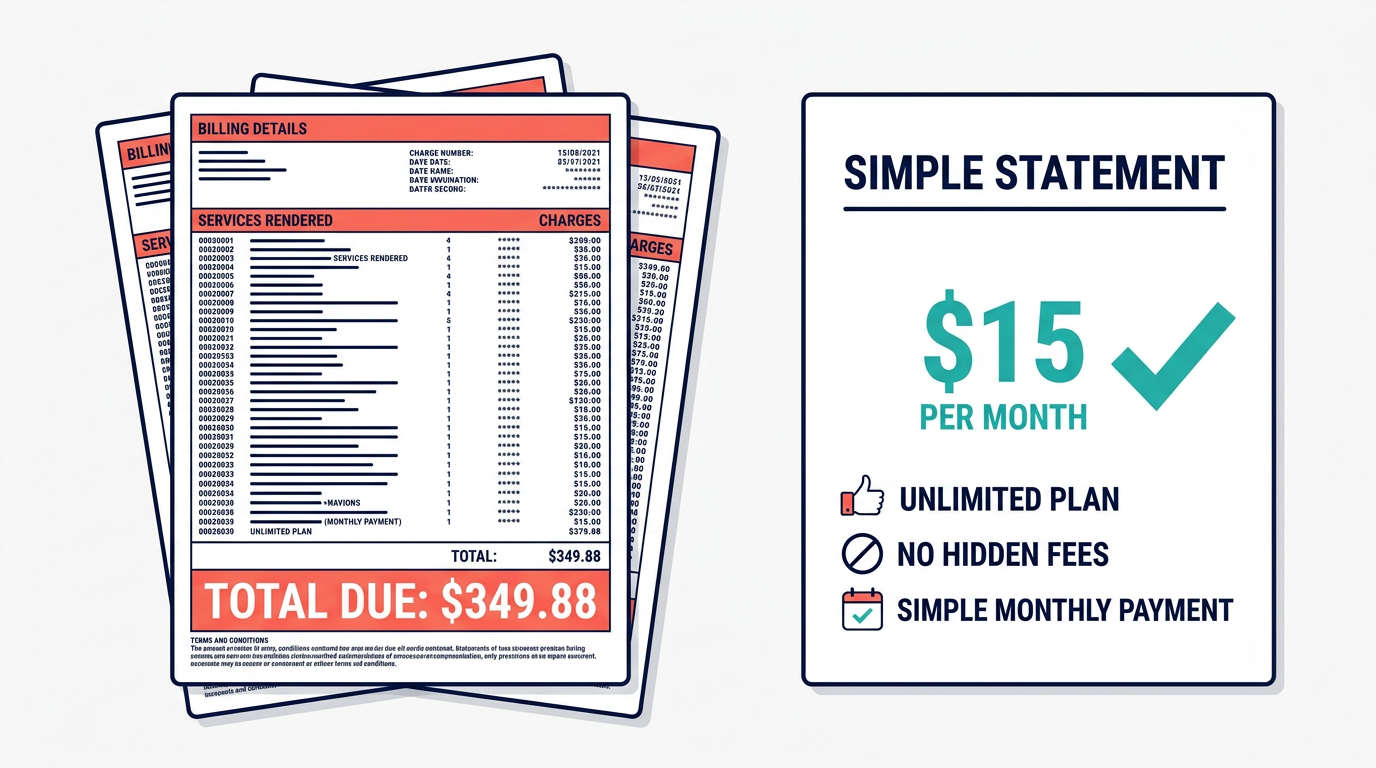
Datadog's median customer pays $152K/year. Upflag's most expensive plan is $588/year.
$15, not $15,000
Most apps built with AI have zero monitoring. The founder finds out something broke when a customer emails them. I don't think that's because they don't care. I think it's because every monitoring tool they look at is built for a 50-person engineering team with a six-figure observability budget.
Free plan, no credit card. Three monitors, one status page, 100 errors a day.