Sentry Alternatives for Solo Devs and Small Teams
Sentry Alternatives for Solo Devs and Small Teams
Sentry is the default answer when someone asks "how do I track errors?" For large teams with SRE staff, it works. But if you're a solo developer shipping with Cursor, Lovable, or Replit, Sentry's setup complexity and pricing probably don't fit how you actually work.
You don't need distributed tracing across 40 microservices. You need to know when your app breaks before your users tell you.
Here are six sentry alternatives worth considering in 2026, sorted by how well they fit someone building alone or with a small team.
What matters when you're picking
Setup time is the biggest filter. If it takes more than 15 minutes, you'll abandon it. AI-generated apps move fast and your monitoring needs to keep up.
After that: can it tell you what broke in plain language? Stack traces are useless if you don't know the codebase line-by-line, and with AI-written code, you often don't. Predictable pricing matters too. Per-event billing means one bad deploy that throws 50,000 errors can blow up your monitoring bill. And since most vibe-coded apps are frontend-heavy, you need client-side coverage, not just server-side.
1. GlitchTip
GlitchTip is open-source and speaks Sentry's SDK protocol. Point your existing Sentry SDK at a GlitchTip instance and everything works. No code changes.
The catch is you run the infrastructure yourself. If your server goes down, your error tracking goes with it. That's fine for side projects but risky for anything making money. Free if self-hosted, or hosted plans start at $4/mo.
2. Highlight.io
Highlight.io pairs error tracking with session replay, so you can watch what a user did before they hit a bug. Open-source with a free tier up to 500 sessions/mo.
It's particularly useful when AI wrote the code and you're trying to figure out what it actually did. The downside: session replay adds bundle weight, and the dashboard takes some time to learn. Paid plans start at $150/mo, which is steep for a solo builder.
3. Better Stack
Better Stack bundles uptime monitoring, log management, and Sentry-compatible error tracking in one place. Free tier available, paid from $29/mo.
If you already use their uptime product, adding error tracking is easy. The trade-off with any all-in-one is that each piece is less deep than a dedicated tool. Their error tracking is newer and less polished than their monitoring, which is solid.
4. Rollbar
Rollbar has been around almost as long as Sentry. Good error grouping, AI-assisted triage, and a straightforward interface. Free up to 5,000 events/mo, paid from $13/mo.
Pricing still scales with event volume, so it's not immune to surprise bills. But it's more predictable than Sentry's model, and the setup is fast.
5. Honeybadger
Honeybadger is the "set it and forget it" option. Clean interface, errors and uptime, nothing else. The interesting thing about their pricing is it's per-project ($49/mo) instead of per-event. No session replay, no log management. Most solo builders don't need those anyway.
6. Upflag
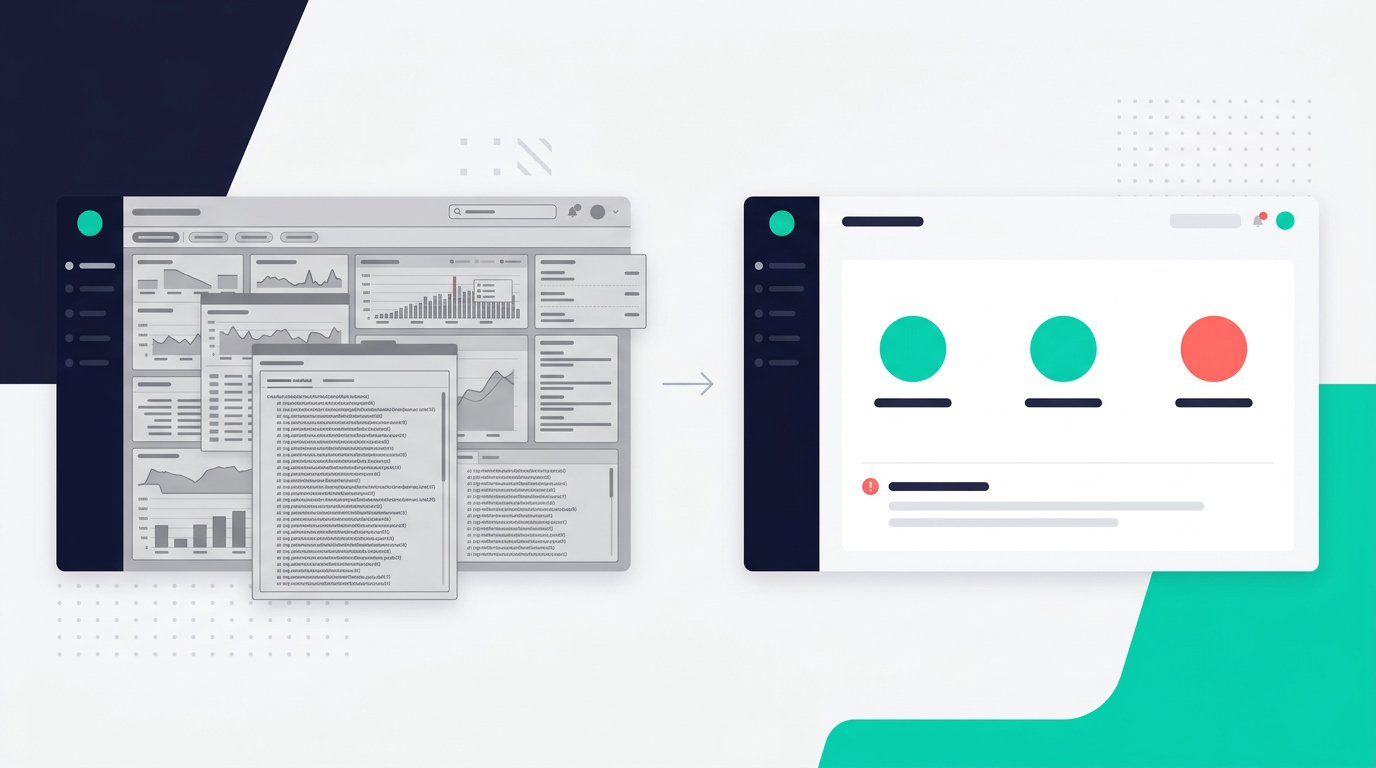
Upflag does something different from the others on this list. Instead of showing you stack traces in a dashboard, it sends plain-English alerts that say what broke and what to look at. Setup is one command: npx upflag init.
I built Upflag specifically for solo devs and vibe coders who ship with AI tools and don't have time to dig through traces. It handles error tracking, uptime checks, and status pages. It's newer and less feature-rich than Sentry. No distributed tracing, no performance monitoring. $15/mo with unlimited subscribers, and there's a free tier.
When Sentry is still the right call
If you have an engineering team, complex distributed systems, and the bandwidth to configure and maintain it, stick with Sentry. Their performance monitoring, release tracking, and cron job monitoring are genuinely useful at that scale.
But if you just shipped an AI-built app and need to know when it breaks, most of that doesn't apply to you.
Quick comparison
| Tool | Setup time | Pricing model | Client-side JS | Self-hosted | Plain-English alerts |
|---|---|---|---|---|---|
| GlitchTip | 30-60 min | Free (self-hosted) | Yes (via Sentry SDK) | Yes | No |
| Highlight.io | 15-30 min | Per-session | Yes + replay | Yes | No |
| Better Stack | 10-15 min | Per-event | Yes | No | No |
| Rollbar | 10-15 min | Per-event | Yes | No | No |
| Honeybadger | 5-10 min | Per-project | Yes | No | No |
| Upflag | 2 min | Per-project | Yes | No | Yes |
The right sentry alternative depends on what you're building and how much time you want to spend on monitoring. For most solo devs, the answer is: as little as possible.